

Caught hidden release deed
Pulled 30 years of transaction history for an Ernakulam plot. Landeed flagged a release deed that the seller hadn't disclosed.
Hari M.2 months ago

Pulled 30 years of transaction history for an Ernakulam plot. Landeed flagged a release deed that the seller hadn't disclosed.
My lawyer wanted the full chain of title. Landeed delivered a clean report — saved a week of SRO visits.
Used Landeed before lending against a Kollam property. The transaction history caught a co-owner's prior gift deed.
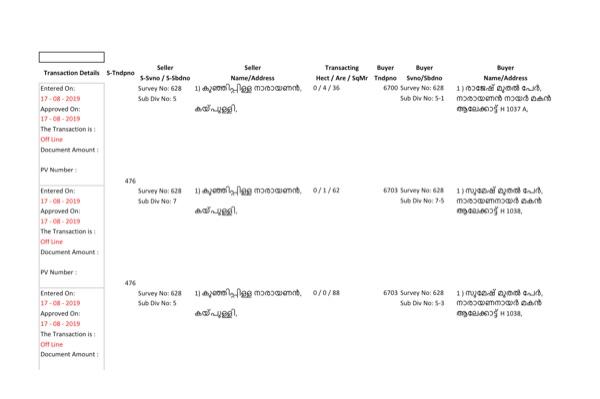
It is a chronological list of every document registered against a property at the Sub-Registrar's office — sale deeds, gift deeds, mortgages, releases, settlements, partitions, court orders — drawn from the Pearl Registration database. It is the chain-of-title view a buyer or lender needs.
District + SRO (mandatory), then Survey number with sub-division (or Block + LP), document number + year if known, party name, and a date range. The more parameters provided, the more precise the result.
A chronological list of all documents on the property, with document type, parties, consideration, document number, registration date, book/volume reference, linked Survey numbers, and SRO details.
The EC is a subset of the transaction history — it shows transactions that create or affect rights (mortgages, sales, releases). A full transaction history is broader, capturing every registered document including ones that may not appear on the EC.
The Pearl database covers all post-digitisation periods (typically 1990s onwards). Pre-digitisation transactions sit in physical SRO records and may require manual extract requests. 13-year and 30-year search windows are common.
Document Number is precise — it returns the exact deed. Survey Number returns every document linked to that parcel over the search window. For chain-of-title work, Survey Number is the right starting point; Document Number is used to pull specific deeds.
It shows the metadata — parties, consideration, dates, document number. To get the contents of a specific deed, request a Certified Document Copy using the document number.
Yes. Useful when tracing inheritance, family-settlement, or fraud cases where one party may have multiple property transactions across SROs. Name-search results are typically narrower (no Survey No filter) so review carefully.
Pearl is Kerala's online registration database maintained by the Department of Registration. Every registered document at any SRO across Kerala is indexed in Pearl. Searches return the metadata index — actual deeds are pulled as certified copies on demand.
As an extract from Pearl, it is a recognised informational document — accepted in bank loan files and for pre-purchase due diligence. For court evidence, a certified copy of each relevant deed is what carries evidentiary weight.

