

Authentic and fast
Very authentic and fast service. All orders executed perfectly.
User2 months ago

Very authentic and fast service. All orders executed perfectly.
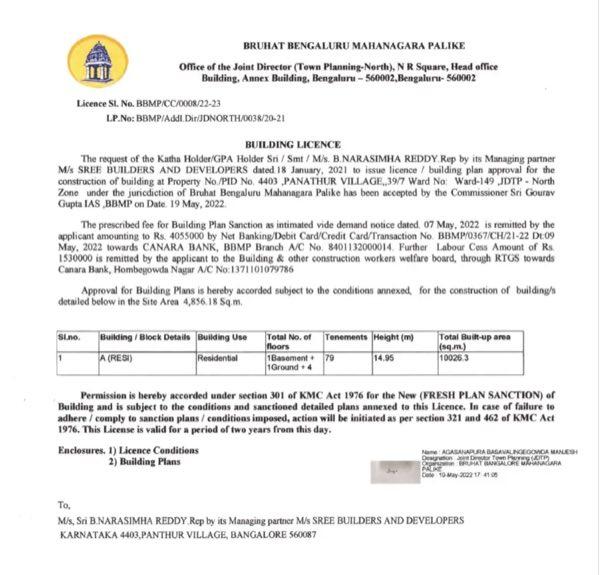
BBMP Plan Approval — formally called Building Plan Sanction — is the official authorisation issued by Bruhat Bengaluru Mahanagara Palike confirming that a proposed construction design complies with all applicable building bye-laws, FAR limits, setback requirements, height restrictions, and zoning regulations. It is the legal permission that must exist before any construction is authorised to begin — and the root document from which all subsequent building approvals flow.
Because every other building approval — Commencement Certificate, Completion Certificate, Occupancy Certificate — derives its validity from the plan sanction. A building constructed without a valid plan sanction has no legitimate path to an OC. Utility connections remain temporary, home loan disbursements can be withheld, BBMP can initiate demolition proceedings, and the property's resale value is permanently compromised. The plan sanction is where the legal identity of a building begins — and where most due diligence failures originate.
FAR is the ratio of a building's total built-up area to the area of the plot it sits on. A FAR of 2.25 on a 2,400 sq ft plot means a maximum of 5,400 sq ft can be built across all floors. FAR is the primary constraint governing how much a developer can build — and therefore how many units can be sold. When a developer sells more units than the sanctioned FAR permits, the excess construction is unauthorised. Buyers of units in FAR-exceeded buildings are purchasing legally deficient assets regardless of what the sale deed says.
These three documents represent the beginning, middle, and end of a building's regulatory lifecycle. Plan Approval sanctions the design before construction begins. The Commencement Certificate authorises construction to start on the basis of that approved plan. The Occupancy Certificate certifies at the end that the completed building matches the approved plan and is fit for occupation. All three must exist in sequence — the absence of any one document is a legal deficiency that cannot be cured by the presence of the others.
You can instantly verify the plan sanction status of any BBMP property on Landeed — confirming whether a plan was sanctioned, the date of sanction, the approved FAR, number of floors, setbacks, and usage classification — before signing any agreement or making any payment to a developer.
A building without plan sanction is unauthorised construction from inception. It cannot legally receive a Commencement Certificate, Completion Certificate, or Occupancy Certificate. BBMP has full authority to issue demolition notices, sealing orders, and compound penalties. Utility connections — BESCOM electricity, BWSSB water — remain on temporary status and can be disconnected. Banks will not lend against the property. Any buyer of such a property assumes the entire legal and financial risk with no recourse against the civic authority.
The sanctioned plan specifies the approved number of floors, FAR utilisation, setbacks, height, and parking provisions. If what is being built on the ground exceeds or deviates from these parameters — more floors, reduced setbacks, higher FAR — the deviation is visible by comparing the sanctioned plan against actual construction. Buyers of under-construction properties should request the sanctioned plan from the developer and compare it against the unit they are purchasing. Deviations that are not regularised before completion will prevent OC issuance.
Yes, if the renovation or addition materially alters the building's structure, footprint, height, or FAR utilisation. Internal modifications that do not affect structural elements or the building's external footprint may not require fresh plan sanction — but additions of floors, extensions of built-up area, or conversion of open areas into enclosed space typically do. Proceeding with significant additions without plan sanction creates the same unauthorised construction risk as original construction without approval.
The issuing authority depends on the planning jurisdiction of the property. BBMP sanctions building plans for properties within its jurisdictional limits — the core city and its extended area. BDA sanctions plans for layouts developed under its authority. Properties in Bengaluru's periphery — Sarjapur, Whitefield, Devanahalli, Anekal, Hesaraghatta — may fall under BMRDA, LPA, or Gram Panchayat jurisdiction, each with its own plan sanctioning authority and building bye-laws. The approval that matters for your property is the one issued by the authority with jurisdiction over your specific plot — not BBMP's approval if your property sits in BDA or Gram Panchayat limits.
The sanctioned number of floors is the absolute legal ceiling for construction on that plot. A developer who adds floors beyond the sanctioned count — a common deviation in Bengaluru — has built unauthorised construction that BBMP can order demolished. Buyers of apartments on floors not covered by the plan sanction are purchasing units with no legal existence — they cannot be registered with a clean title, cannot receive OC coverage, and cannot be mortgaged. Always verify that the floor your unit sits on is within the sanctioned floor count.
Rajasthan and several other states have run periodic regularisation schemes for unauthorised constructions. Karnataka has had limited and conditional regularisation provisions — but these are not permanent, not guaranteed, and not applicable to all types of deviations. Buyers who purchase properties with known deviations banking on future regularisation are making a speculative bet on government policy — not a sound property investment. The risk of non-regularisation, with its consequence of permanent legal deficiency, sits entirely with the buyer.

