

Quick and reliable
Got the BBMP CC details instantly. Very useful for property verification.
Bengaluru User2 months ago

Got the BBMP CC details instantly. Very useful for property verification.
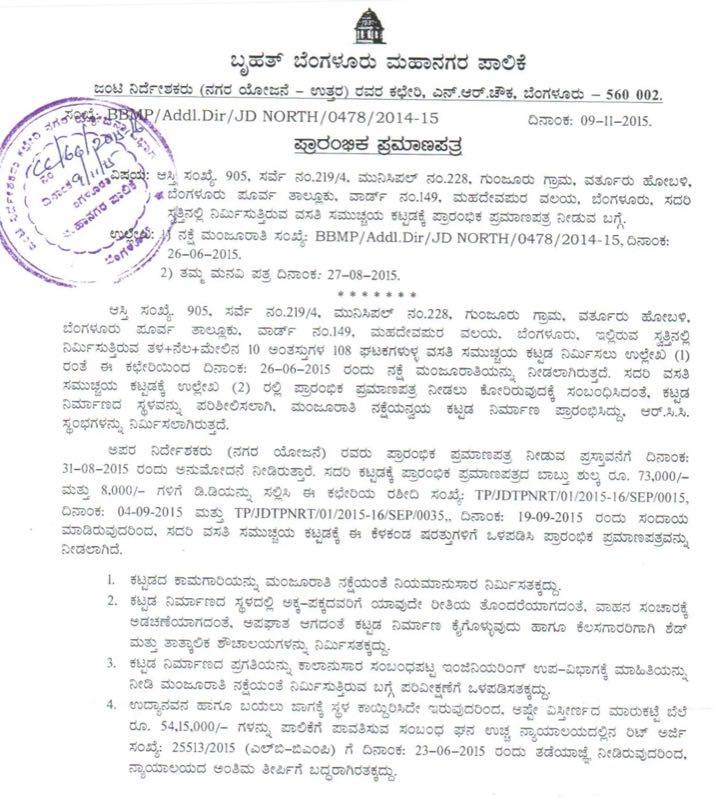
A BBMP Commencement Certificate is an official document issued by Bruhat Bengaluru Mahanagara Palike authorising a property owner or developer to begin construction on a plot after the building plan has been reviewed and sanctioned. It is the legal permission to break ground — construction that begins without a CC is unauthorised from inception, irrespective of how the structure looks or how far construction has progressed.
A Building Plan Sanction is BBMP's approval of the proposed construction design — it says "this plan is acceptable." A Commencement Certificate is the subsequent authorisation to actually begin construction on the ground — it says "you may now build." The sanction approves the design; the CC permits the act of construction. Both are required, and the CC cannot be issued without a prior building plan sanction in place.
These two documents bookend the construction lifecycle. The Commencement Certificate is issued at the beginning — authorising construction to start. The Occupancy Certificate is issued at the end — certifying that the completed building is fit for occupation. A property without a CC was built without authorisation. A property without an OC was built without confirmed compliance. Both absences carry serious legal and financial consequences, but they represent different stages of the same regulatory chain.
If a developer commenced construction without a valid CC, every subsequent approval — Completion Certificate, Occupancy Certificate, Khata — is built on an unauthorised foundation. The building may never receive an OC, utility connections may remain temporary, your home loan final disbursement may be withheld, and BBMP has the authority to issue demolition or sealing orders. Checking the CC before signing a sale agreement is the earliest and most important due diligence step for any under-construction purchase.
No. Construction without a CC is a violation of BBMP building bye-laws. In practice, some developers begin site preparation or foundation work before the CC is issued — which technically constitutes unauthorised commencement. Buyers who purchase such properties before the CC is obtained are assuming the risk that BBMP may not sanction the construction as planned, requiring modifications that affect unit sizes, floor counts, or amenities promised in the sale agreement.
You can instantly verify the CC status of any BBMP property on Landeed by entering the property or project details — confirming whether a Commencement Certificate was issued, the date of issue, and the construction parameters authorised under it — before signing any agreement or making any payment.
Yes. Any construction within BBMP jurisdiction — apartments, independent houses, villas, commercial buildings, and mixed-use structures — requires a Commencement Certificate before construction begins. The requirement applies regardless of plot size, building height, or whether the construction is by a large developer or an individual homeowner. The only exemption is minor repairs or internal modifications that do not alter the building's structure or footprint.
The CC specifies the plot details, the name of the owner or developer, the date of authorisation, the sanctioned number of floors, the approved floor area ratio utilisation, the permissible height, the mandated setbacks on all sides, and the approved use — residential, commercial, or mixed. Any construction that exceeds these parameters is a deviation from the sanctioned plan, which can jeopardise the Completion Certificate and Occupancy Certificate.
Deviations — such as additional floors, reduced setbacks, or excess FAR — are flagged during BBMP inspections at the plinth and completion stages. Minor deviations may be regularisable under applicable schemes; significant deviations can result in refusal of the Completion Certificate and Occupancy Certificate, demolition orders for non-compliant portions, and legal liability for the developer. Buyers of properties with known deviations inherit these risks entirely upon purchase.
Yes, entirely. A Khata is a revenue record that registers a property in BBMP's assessment register for property tax purposes — it is a taxation document. The Commencement Certificate is a construction authorisation document. A Khata can exist for a property that never had a valid CC, and a CC can exist without a Khata being updated. Both are required as part of complete property due diligence, but they serve completely different legal purposes.
The issuing authority depends on the planning jurisdiction of the property. BBMP issues Commencement Certificates for properties within its jurisdictional limits. BDA issues equivalent authorisations for layouts and buildings under its purview. Properties in Bengaluru's peripheral areas — Sarjapur, Whitefield, Devanahalli, Anekal — may fall under BMRDA, LPA, or Gram Panchayat jurisdiction, each with its own authorisation process. Always verify the correct planning authority for your specific property before interpreting any approval document.
Most banks and NBFCs require the CC as part of the documentation for home loan sanction on under-construction properties. A missing CC signals to the lender that construction is unauthorised — making the property unacceptable as loan collateral. Some lenders may proceed with partial approvals in anticipation of CC issuance, but this carries significant risk for the borrower if the CC is delayed or denied. Never interpret a lender's initial approval as confirmation that the CC situation is acceptable.

