

Authentic and fast
Very authentic and fast service. All orders executed perfectly.
User2 months ago

Very authentic and fast service. All orders executed perfectly.
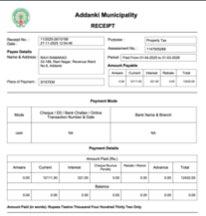
A CDMA Property Tax Receipt is an official document issued by the Commissioner and Director of Municipal Administration of Andhra Pradesh confirming that property tax has been paid for a specific property under a specific owner's name for a defined tax period. It functions simultaneously as a payment acknowledgement and a documentary record of the property's municipal assessment — capturing the PTIN, owner name, property address, assessed value, and tax components paid.
PTIN — Property Tax Identification Number — is the unique reference number assigned to every property assessed under an Urban Local Body in Andhra Pradesh. It is the primary identifier linking a property to its municipal tax history, ownership assessment, and ULB records. For any property transaction, loan application, mutation proceeding, or legal verification involving an Andhra Pradesh urban property, the PTIN is the starting point — without it, associated municipal records cannot be reliably retrieved or cross-referenced.
Property tax in Andhra Pradesh is calculated on the basis of Annual Rental Value — the assessed notional rental income the property could generate — determined by the Urban Local Body based on location, built-up area, type of construction, age of building, and occupancy status. The total tax liability includes general tax, library cess, drainage tax, and applicable surcharges — all itemised in the CDMA receipt.
You can instantly access your Andhra Pradesh CDMA Property Tax Receipt on Landeed by selecting your ULB and entering your PTIN — retrieving current and historical tax payment records across all AP Urban Local Bodies without navigating multiple municipal portals or visiting the ULB office.
Property tax in Andhra Pradesh is payable in two half-yearly instalments — the first covering April to September and the second covering October to March. Both instalments must be paid to maintain a clean tax compliance record. Arrears accumulate with penalty interest, and persistent non-payment can trigger demand notices, attachment proceedings, and restrictions on obtaining building plan sanctions, utility connections, and mutation clearances.
Property tax receipts are widely accepted as supporting evidence of ownership and possession in Andhra Pradesh — particularly in mutation proceedings, legal disputes, succession claims, and institutional due diligence. They are not standalone title documents. A receipt in your name establishes assessed ownership and payment continuity — it does not confirm that the title is clean, encumbrance-free, or legally transferable.
Verify four things before proceeding with any transaction. First, confirm the owner name on the receipts matches the seller's name and registered sale deed consistently. Second, check for gaps in payment history — missing half-years indicate default, dispute, or a period of unresolved ownership transition. Third, verify that no outstanding arrears exist that will transfer to you as the new owner post-registration. Fourth, confirm that the PTIN and property address on the receipts match the property being sold exactly.
Unpaid property tax in Andhra Pradesh attracts penalty interest on overdue amounts from the due date. Persistent non-payment results in the ULB issuing demand notices, followed by attachment or distress proceedings against the property. Outstanding dues transfer to the new owner upon purchase — making arrear verification a mandatory pre-purchase step.
Yes. CDMA-AP's digital records include historical payment data for assessed properties going back several years, subject to the extent of digitisation completed for that specific ULB and property. Historical receipts are particularly valuable when verifying ownership continuity across ownership transitions, investigating gaps in payment history, or establishing long-term possession in legal proceedings.
No. CDMA property tax applies exclusively to properties within Urban Local Body jurisdictions — municipal corporations, municipalities, and Nagar Panchayats. Agricultural land outside ULB limits is subject to land revenue records maintained by the Revenue Department — Pahani, Adangal, and ROR records — rather than municipal property tax.

