

Essential for property buyers
Verified building permission before buying my flat. Found that the construction matched sanctioned plans. Peace of mind.
Hyderabad Buyer1 month ago

Verified building permission before buying my flat. Found that the construction matched sanctioned plans. Peace of mind.
TGBPASS — Telangana Government Building Permission Approval Self-certification System — is the online portal through which building permissions, construction approvals, and occupancy certificates are issued across Telangana. It is the single-window system for all building-related approvals in the state, covering residential, commercial, and industrial constructions within municipal and panchayat jurisdictions.
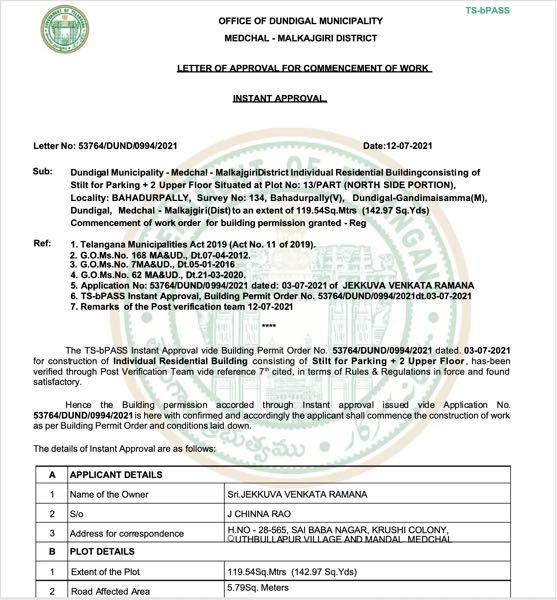
A TGBPASS Building Permission document contains the file number, applicant name, property address, survey/plot details, sanctioned built-up area, number of floors approved, FAR (Floor Area Ratio) permitted, setback requirements, and the issuing authority details. It also includes conditions attached to the approval and the validity period of the permission.
Building permission verification is critical because it confirms that the construction is legally sanctioned and complies with local building regulations, zoning laws, and safety norms. Purchasing a property with unapproved or deviated construction exposes you to demolition risk, legal penalties, and difficulty in obtaining home loans, resale, or mutation.
You can instantly verify TGBPASS building permission on Landeed by entering the file number. This retrieves the official approval record directly from TGBPASS, showing sanctioned parameters, approval status, and any conditions or deviations recorded against the file.
FAR — Floor Area Ratio — is the ratio of the total built-up area to the plot area. It determines how much construction is permissible on a given plot. Exceeding the sanctioned FAR is a building violation that can result in penalties, demolition orders, or rejection of occupancy certificate. Always verify that the actual construction matches the FAR approved in the building permission.
Setbacks are the mandatory distances that a building must maintain from plot boundaries — front, rear, and sides. They ensure light, ventilation, fire safety, and access. Setback violations are common deviations that can invalidate building permissions and result in enforcement action. The TGBPASS approval specifies the required setbacks for each side of the plot.
Building permission is the approval to commence construction according to sanctioned plans. Occupancy certificate (OC) is issued after construction completion, confirming that the building was constructed as per approved plans and is fit for occupation. Both are essential — permission to build and permission to occupy are separate regulatory clearances.
Most banks and financial institutions require valid building permission and occupancy certificate as part of property due diligence before sanctioning home loans. Properties without TGBPASS approval or with significant deviations are typically rejected for financing, or the loan amount is significantly reduced to account for legal risk.
Deviations from sanctioned plans — additional floors, exceeded FAR, encroached setbacks — can result in show-cause notices, penalties, and demolition orders. Minor deviations may be regularised through compounding fees, but major violations may require structural modifications or demolition. Always verify that actual construction matches TGBPASS approval before purchase.
TGBPASS building permission is typically valid for three years from the date of issue, within which construction must be completed. Extensions may be granted on application before expiry. Expired permissions require fresh applications and approvals. The validity period is specified in the approval document.
For apartments, TGBPASS approval confirms that the entire building project was sanctioned with the correct number of units, floors, and common areas. Each flat buyer should verify that the building has valid permission and that the unit count, floor they are purchasing, and common area allocation match the sanctioned plans.
Yes. Building permission can be revoked if it was obtained through misrepresentation, if construction deviates significantly from sanctioned plans, or if violations of building regulations are discovered during inspections. Revocation renders the construction illegal and exposes the owner to demolition and penalty proceedings.
Yes. Structural alterations, additions, floor extensions, and changes in use require fresh or amended building permission through TGBPASS. Unauthorised modifications can result in enforcement action and complicate future transactions. Always obtain approval before undertaking significant alterations to an existing building.

