

Quick and reliable
Got the CDMA property tax receipt instantly. Very useful for property verification.
Hyderabad User2 months ago
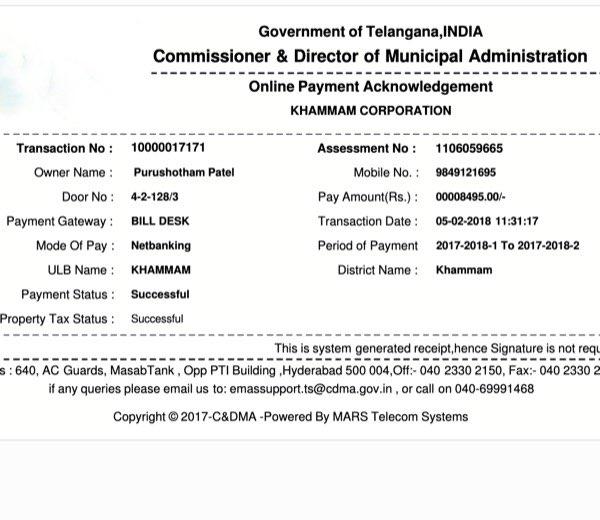

Got the CDMA property tax receipt instantly. Very useful for property verification.
A CDMA Property Tax Receipt is an official document issued by the Commissioner and Director of Municipal Administration confirming that property tax has been paid for a specific property under a specific owner's name for a given tax period. It serves as both a payment acknowledgement and a documentary record of the property's assessment details — including the PTIN, owner name, property address, and tax components paid.
PTIN stands for Property Tax Identification Number — the unique reference number assigned to every assessed property in Telangana's municipal records. It is the primary identifier that links a property to its tax payment history, ownership assessment, and municipal records. For any property transaction, loan application, or legal proceeding involving a Telangana urban property, the PTIN is the starting point for verification — without it, none of the associated records can be reliably accessed or cross-referenced.
Property tax in Telangana is calculated on the basis of Annual Rental Value (ARV) — an assessed notional rental income the property could generate — for most residential and commercial properties. The ARV is determined by the Urban Local Body based on factors including location, built-up area, type of construction, and age of the building. The total tax liability includes general tax, library cess, drainage tax, and any applicable surcharges — all of which are itemised in the CDMA receipt.
GHMC — Greater Hyderabad Municipal Corporation — is the Urban Local Body responsible for property tax assessment and collection within Greater Hyderabad's jurisdiction. CDMA is the state-level authority that oversees and digitises property tax records across all Urban Local Bodies in Telangana — including GHMC, all municipal corporations, municipalities, and Nagar Panchayats. A CDMA receipt for a Hyderabad property is a GHMC property tax receipt accessed through the CDMA system — the two are not competing records but the same record at different levels of the administrative hierarchy.
You can instantly access your Telangana CDMA Property Tax Receipt on Landeed by entering your PTIN — retrieving your current and historical tax payment records without navigating multiple ULB portals or visiting the municipal office.
A property tax receipt does three things simultaneously that no other document does: it confirms the property is officially assessed and exists in municipal records, it names the owner on record at the time of payment, and it establishes that tax obligations have been met without default. A gap in tax payment history — missed half-years, arrears, or a change in owner name mid-history — is a red flag that warrants investigation before any transaction proceeds. Continuous tax receipts in a consistent owner name are one of the strongest indicators of undisputed, unencumbered ownership.
Property tax in Telangana is payable in two half-yearly instalments — the first covering April to September and the second covering October to March. Both instalments must be paid to maintain a clean tax compliance record. Arrears accumulate with penalty interest, and unpaid dues can result in notices, attachment proceedings, or difficulty in obtaining clearances for property transactions and building approvals.
Property tax receipts are widely accepted as supporting evidence of ownership and possession in Telangana — particularly in mutation proceedings, legal disputes, and institutional due diligence. However, they are not standalone title documents. A tax receipt in your name establishes that you are assessed as the owner and have been paying taxes — it does not by itself confirm that the title is clean, encumbrance-free, or legally transferable. It must be read alongside the registered sale deed, Encumbrance Certificate, and mutation records for a complete ownership picture.
Verify four things: first, that the owner name on the receipts matches the seller's name and the sale deed consistently; second, that there are no gaps in payment history — missing half-years indicate either default or a period when the property was disputed or in transition; third, that there are no outstanding arrears that will transfer to you as the new owner post-registration; and fourth, that the PTIN and property address on the receipts match the property being sold — discrepancies in address or survey number details can indicate assessment errors that complicate future transactions.
Unpaid property tax in Telangana attracts penalty interest on overdue amounts. Persistent non-payment can result in the Urban Local Body issuing demand notices, followed by attachment proceedings against the property. Outstanding tax dues transfer to the new owner upon purchase — making arrear verification a mandatory pre-purchase step. Additionally, properties with outstanding tax dues face difficulties in obtaining building plan sanctions, utility connections, and mutation clearances.
Yes. CDMA's digital records include historical payment data for assessed properties going back several years, subject to the extent of digitisation for that specific ULB and property. Historical receipts are particularly valuable when verifying ownership continuity, investigating a gap in payment history, or establishing possession in legal proceedings. Landeed surfaces all available historical CDMA tax records for your PTIN in a single retrieval.
No. CDMA property tax applies exclusively to properties within urban local body jurisdictions — municipal corporations, municipalities, and Nagar Panchayats. Agricultural land falls outside ULB jurisdiction and is subject to land revenue records maintained by the Revenue Department — including Pahani, Adangal, and ROR 1B records — rather than municipal property tax. If a previously agricultural plot has been converted for urban use and falls within ULB limits, it will have CDMA assessment records. Verify jurisdiction before assuming which tax regime applies.
These documents answer entirely different questions. A property tax receipt confirms that municipal tax obligations have been met and identifies the assessed owner — it speaks to compliance and possession. An Encumbrance Certificate records all registered transactions — sales, mortgages, leases — against a property over a specified period, confirming whether the title is free of registered charges. Both are essential for complete due diligence, but neither substitutes for the other. A property can have clean tax receipts and still carry a mortgage lien that only the EC reveals.

