

Quick and reliable
Got my Chausala Jamabandi instantly. Very useful for verifying land records before purchase.
Rajasthan User1 month ago
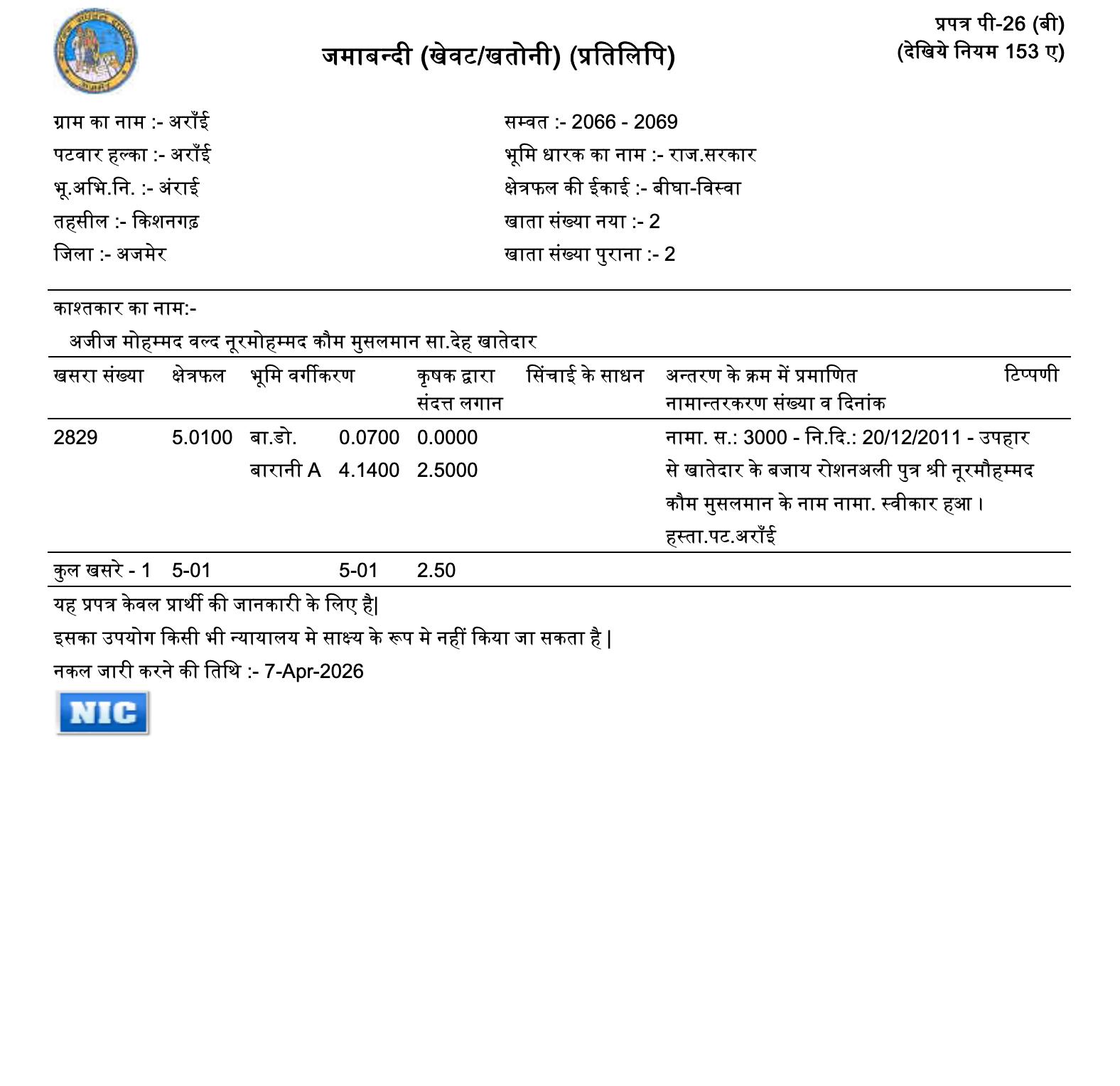

Got my Chausala Jamabandi instantly. Very useful for verifying land records before purchase.
Chausala Jamabandi is an official land revenue record maintained by the Revenue Department of Rajasthan. It is a consolidated record that contains details about land ownership, area, crop patterns, and revenue assessments. The term "Chausala" refers to a four-year cycle of land records verification and update carried out by the revenue authorities.
A Chausala Jamabandi contains comprehensive land details including: khata number, khasra number, land area in hectares and bighas, owner names and shares, land classification (agricultural, residential, commercial), crop details, water source information, revenue assessment, and mutation history. It serves as the primary ownership evidence for agricultural land in Rajasthan.
Khata number is the account number assigned to a landowner in revenue records, while Khasra number is the unique plot or survey number assigned to a specific piece of land. If you know the owner's account number, search by Khata. If you know the specific plot number, search by Khasra. Both methods will retrieve the Jamabandi record.
Chausala Jamabandi is essential for property transactions in Rajasthan because it establishes legal ownership and possession of agricultural land. Banks require it for agricultural loans, buyers need it to verify ownership before purchase, and it is necessary for mutation proceedings. The four-yearly verification ensures records are current and accurate.
You can instantly access Rajasthan Chausala Jamabandi on Landeed by selecting your village, choosing whether to search by Khata or Khasra number, and entering the respective number. The system retrieves the official record directly from government sources.
Chausala Jamabandi records are updated on a four-year cycle by the Revenue Department. However, mutations and ownership changes are recorded continuously. For property transactions, always verify that the record reflects the latest ownership status and check for any pending mutations.
Yes, Chausala Jamabandi is admissible as evidence of ownership and possession in legal proceedings. It is a government-maintained record that carries evidentiary value. However, for complete title verification, it should be read alongside the registered sale deed and mutation records.
Before buying land, verify: the seller's name matches the Jamabandi record, the land area matches what is being sold, there are no disputes or encumbrances noted, the land classification permits your intended use, all shares are being transferred if jointly owned, and there are no pending mutations that could affect ownership.
Regular Jamabandi is the annual land record, while Chausala Jamabandi is a comprehensive four-yearly verification that consolidates all changes, corrections, and updates from the intervening period. Chausala Jamabandi is considered more authoritative as it involves field verification and settlement operations.
If you find errors in your Chausala Jamabandi — wrong owner name, incorrect area, missing share — you should file an application for correction with the concerned Tehsildar along with supporting documents. The correction will be processed and reflected in subsequent records after due verification.
Yes, banks and financial institutions mandatorily require Chausala Jamabandi as part of loan documentation for agricultural credit, crop loans, and land mortgage loans. It establishes ownership, land extent, and helps assess the loan amount based on land value and productivity.
The Chausala settlement operation is conducted every four years across Rajasthan. During this period, revenue officials verify land records through field visits, update ownership based on mutations, correct errors, and consolidate all changes. Between Chausala cycles, annual Jamabandis reflect ongoing mutations.

