
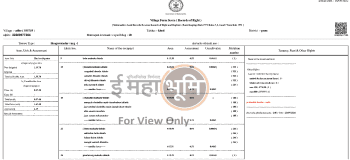
Maharashtra Ferfar Extract (Mutation Register)
Get Ferfar & Varas Nond — Now view online on mobile!
Overview
Maharashtra Ferfar Extract (Mutation Register) is now available on your mobile. Enter the village and Ferfar number on Landeed to download the official mutation record instantly. Bought property, inherited it, or received it as a gift? Without Ferfar registration your name will not appear on the Satbara.
Use cases
Why Landeed?

FAQs
What is Ferfar?
Ferfar (Mutation) is the official record of land ownership change. For any reason — sale, inheritance, gift — if ownership changes, Ferfar must be registered.
How to do Varas Nond?
Take death certificate and Varas certificate to Talathi office and apply for Ferfar. After inquiry, Ferfar is approved and heirs' names appear on Satbara.
What documents are needed for Varas Nond?
Death certificate, Varas certificate, deceased's Satbara, Aadhaar cards of all heirs, affidavit, and Ferfar application.
How to get Varas Certificate?
Apply at Tehsildar office. Attach death certificate, ration card, Aadhaar cards. Get Varas certificate in 15-30 days.
How to view old Ferfar records?
Use "Old Ferfar/Satbara" option on Landeed. For records before 1990, visit Talathi office.
How many days does Ferfar take?
Usually 30-60 days for Ferfar approval. Includes inquiry, notice, and objection period.
What's the difference between Ferfar and Satbara?
Ferfar is record of ownership change. Satbara is current ownership document. Satbara updates after Ferfar approval.
Where to view Bhumi Abhilekh Ferfar?
Bhumi Abhilekh Ferfar can be viewed on Mahabhulekh (bhulekh.mahabhumi.gov.in) or Landeed App.
Do daughters have inheritance rights?
Yes! As per 2005 Hindu Succession Act amendment, daughters have equal inheritance rights like sons.
How to download Ferfar Extract PDF?
On Landeed App: Select village → Enter Ferfar number → Press "Download PDF" button.
What are the different types of Ferfar / mutation?
| Transfer Type | Typical Documents |
|---|---|
| Purchase / Sale | Registered sale deed, Satbara, tax receipt |
| Inheritance (Varas Nond) | Death certificate, Varas certificate, affidavit |
| Gift / Donation | Registered gift deed, acceptance letter |
| Partition / Family arrangement | Partition deed / memorandum, consent letters |
| Court Order | Certified court order, compliance report |
| Consolidation / Exchange | Government order, survey sketches |
How to do Varas Nond (inheritance mutation)?
Varas Nond (Inheritance Mutation) registers a deceased person's land in their heirs' names.
- Get Death Certificate: Obtain from Gram Panchayat / Municipality.
- Get Varas Certificate: Apply at Tehsildar office; it contains all heirs' names.
- Apply at Talathi Office: Submit Ferfar application with all required documents.
- Inquiry & Notice: Talathi conducts inquiry and notice is posted in the village.
- Ferfar Approved: If there are no objections, Ferfar is approved and names appear on Satbara.
Which documents are required for Varas Nond?
- Death Certificate: Gram Panchayat / Municipality
- Varas Certificate: Tehsildar Office
- Deceased's Satbara: Mahabhulekh / Landeed
- Aadhaar Cards of all heirs
- Ferfar Application (Form): Talathi Office
- Affidavit: Notary
- Passport size Photo
How to get a Varas Certificate?
Varas Certificate (Varas Pramanpatra) is issued by the Tehsildar office.
- Fill application form — obtain from Tehsil office.
- Attach documents:
- Death certificate
- Ration card (with all family names)
- Aadhaar cards of all heirs
- Affidavit
- Pay fee — approximately ₹50–₹100 (varies by Tehsil).
- Inquiry by Talathi / Mandal officer.
- Receive certificate — typically within 15–30 days.
Sample formats of Varas Certificate are easily available online for reference.
What does the Hindu Succession Act say about inheritance?
- Son / Daughter: Equal rights (after 2005 amendment)
- Wife / Husband: Equal share
- Mother: Class I heir
- Widowed daughter-in-law: Rights in husband's share
If a Will exists, distribution follows the Will. If there is no Will, property is distributed equally as per law. Daughters have equal rights since 2005.
How do I view old Ferfar records?
Old Ferfar (legacy mutation) records can be accessed in multiple ways:
- After 2010: Mahabhulekh / Landeed online
- 1990–2010: Talathi office (online if digitized)
- Before 1990: Talathi office — physical Ferfar register
On Landeed:
- Select village
- Select "Old Ferfar/Satbara" option
- Select year
- Enter Ferfar number
- View Old Ferfar, Satbara, and 8A
How to view Ferfar on Landeed?
- Select Village / Division: District → Taluka → Village
- Enter Ferfar Number: Enter mutation number / Ferfar number.
- View Ferfar: Your Ferfar extract appears on screen; download the PDF if needed.
Don't know your Ferfar number? Check the Satbara extract — recent Ferfar numbers are mentioned there, or ask at the Talathi office.
Ferfar Extract vs Satbara — what is the difference?
- Ferfar Extract: Shows ownership change history; used to verify mutation entries. Each record typically represents one transfer.
- Satbara (7/12): Shows current ownership and crop information; used for regular transactions and loans. It is updated after Ferfar is approved.
Connection: Once Ferfar is approved, the new owner's name is updated on the Satbara.
Need some help?

