

Got village Khatauni in minutes
Got my village Khatauni in minutes — the search worked even with just the Khatedar's name.
Rajeev S.2 months ago

Got my village Khatauni in minutes — the search worked even with just the Khatedar's name.
Used Landeed for a Gata search before signing my plot deal in Hardoi. Team walked me through the report; saved a costly mistake.
Great app for UP land records. Both soft copy and printed copy delivered on time.
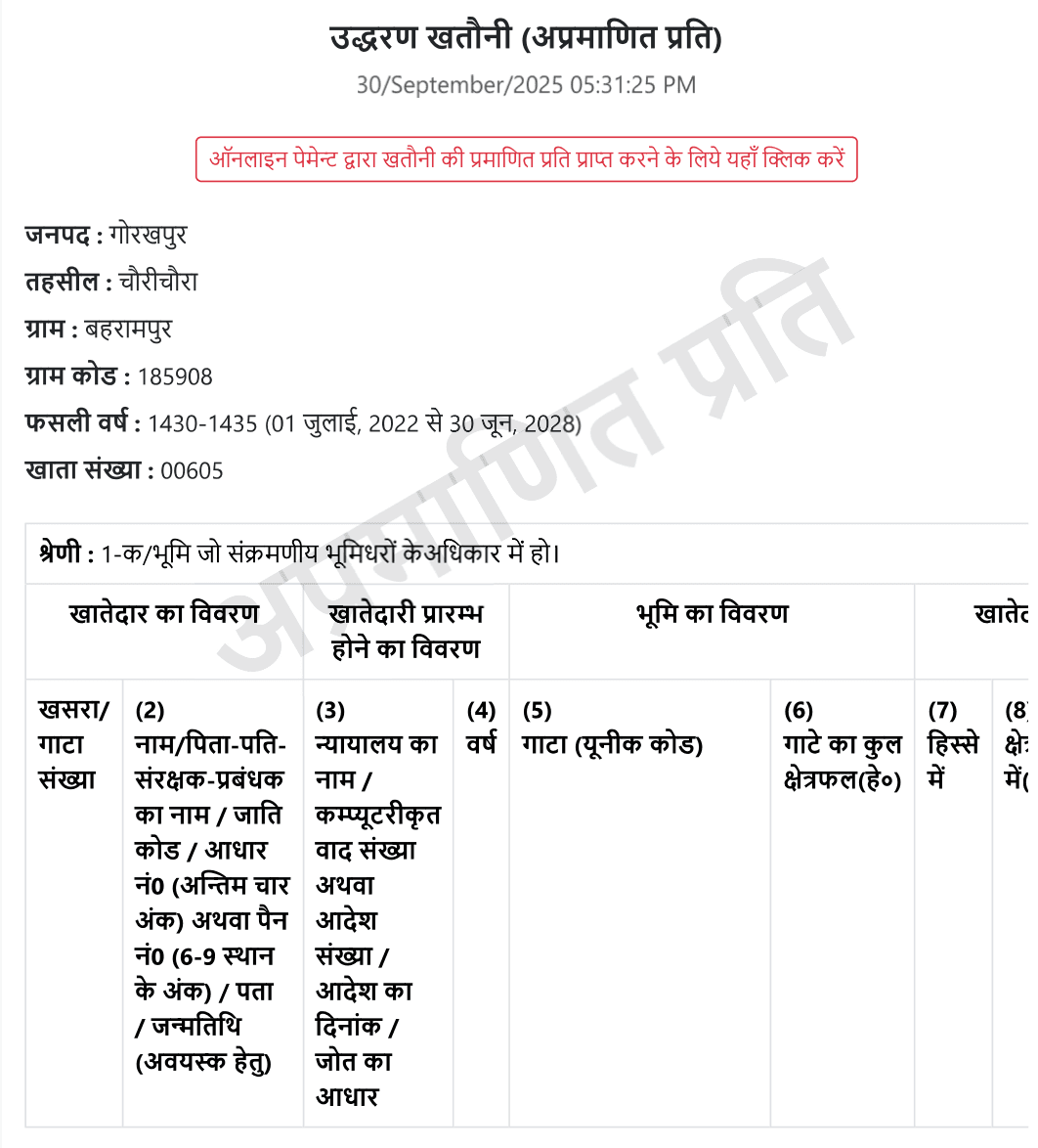
Khasra Khatauni is the digital Record of Rights for rural land in Uttar Pradesh, also commonly called UP Bhulekh. It lists the landholder's account (Khata), the plots (Khasra/Gata) they own in a village, the area, classification, and the history of mutations.
At minimum: District, Tehsil, and Village. After that, you can search by Gata Sankhya (Khasra number), Khatauni number, or Khatedar name. Mutation number is helpful if you have it.
Khatedar name(s) with share, full list of Gatas/Khasras under the Khata, area in hectares (bigha/biswa where shown), land classification, crop and irrigation status, annual revenue, mutation history, and any recorded encumbrances.
Common reasons: wrong District/Tehsil/Village selection, mismatched Gata or Khatauni number, owner name spelled differently in the record, a recent mutation not yet reflected (15–30 day lag), or the village still in a pre-digitisation backlog. Pre-2000 records may need a manual Tehsil request.
Khasra Khatauni is the textual Record of Rights showing owner, area, and classification. UP Bhu Naksha is the cadastral map showing the plot polygon, boundaries, and adjoining plots. For complete due diligence you typically check both.
Khasra (or Gata) is the plot number assigned to a piece of land. Khata is the account number of the landowner. Khatauni is the complete RoR document listing all Khasras held under one Khata. One Khata can contain many Khasras; the Khatauni is the rendered statement.
Yes. After selecting District, Tehsil, and Village, you can search by Khatedar (owner) name. The system returns matching Khatauni entries with all their Gatas. This is useful when Khasra/Khatauni numbers are unknown.
Mutations show up only after the Tehsildar passes the order and the Lekhpal records it — typically a 15–30 day lag from sale-deed registration. Pending court cases are not reflected on UP Bhulekh; they need to be checked separately at the relevant court or via the Revenue Court system.
The online copy is an informational copy, accepted for KYC, loan applications, scheme verification, and most due-diligence purposes. For court submissions or mortgage execution, a certified Khatauni copy (with paper revenue stamp from Jan Seva Kendra) is needed.
The primary unit is hectare. Older records and informal use also reference bigha and biswa, with conversions that vary by region (1 Pucca Bigha ≈ 0.253 hectares in most of UP). The Khatauni always shows hectares for legal clarity.

